Monash University Caulfield Campus Cafe and Landscape Terrace Renovation Design Case
Monash University Caulfield Campus Cafe and Landscape Terrace Renovation Design Case
The renovation project of Building H at Monash University Caulfield Campus in Australia was undertaken by Jackson Clements Burrows Architects, who innovatively designed a 1100 square meter basement to create a multifunctional complex that integrates teaching, socializing, and leisure. The project is based on the core concept of "natural integration and flexible regeneration", successfully achieving a dual breakthrough in spatial efficiency and aesthetic value.
[Design Highlights]
Light and Shadow Reconstruction: Demolishing the original enclosed structure, introducing a 3.5-meter-high ceiling and full glass curtain wall, increasing natural light coverage by 65%, and forming a transparent visual corridor with outdoor stepped terraces, reshaping the vitality of campus public spaces.
Function matrix:
A smart speech hall that can accommodate 200 people is equipped with noise reduction system and visual interaction equipment
Bi directional sliding partitions enable scene switching between conference rooms and coffee areas
The central modular booth supports 15 layout combinations, with a daily peak service of 1800 people
24-hour intelligent kitchen adopts modular dishwashing system and rail logistics transmission
Ecological interface: The 320 ㎡ outdoor terrace uses vertical greening technology to plant 136 local weather resistant plants, and is equipped with an inductive spray system to maintain the microclimate balance, which has won LEED green certification.
[Spatial Narrative]
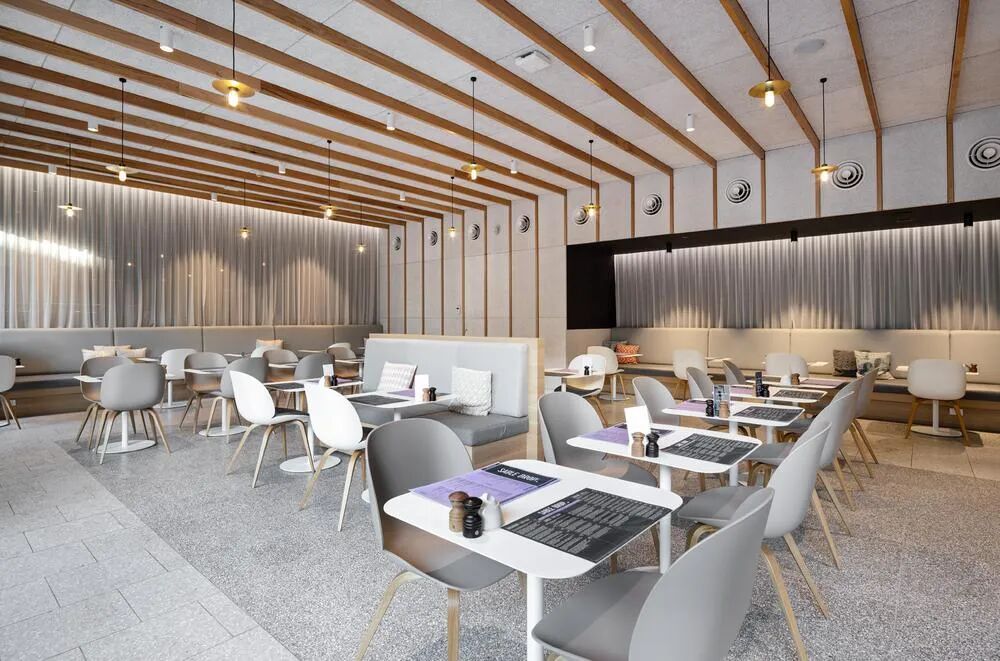
The entrance area is constructed with a soft transition of light gray terrazzo and walnut lattice, and a customized wavy metal screen ensures privacy and maintains a sense of openness in the space. The operation period adopts the "day coffee and night wine" mode: during the day, the adjustable desktop can meet the meeting needs of 40 people; Automatically switch to banquet mode in the evening, with retractable partitions and track spotlights quickly creating a social scene.
Sustainable Strategy
The building facade is embedded with photovoltaic glass curtain walls, with an annual power generation of 38000 kilowatt hours; Rainwater collection system provides landscape irrigation and sanitation water; Customized furniture is made of bamboo fiber composite material, with a degradation rate of 92%. Since its launch in 2018, this project has received 23 delegations from international educational institutions and has become a benchmark case for space renovation in Australian universities.



 Chinese
 English
 French
 Spanish
 Russian
 Arabic