Eastern Aesthetics in Office Space Design: The Beijing Office Design of Shui Zui Zhongguo
Amid the increasing homogenization of commercial environment design, how to integrate Eastern aesthetics with contemporary office needs has become an important direction for cultural brand spaces to explore. The Shui Zui Zhongguo Beijing office space, designed by Cui Shu and Li Hui of CUN寸DESIGN, is located in the Baiziwan Campus and covers 1000 square meters, divided into a 600-square-meter office area and a 400-square-meter cultural space called “Shui Garden.” It presents a spatial practice that deeply integrates “human and nature,” “soft furnishings design,” and “commercial environment design.”
The Dual Expression of Eastern Aesthetics: Garden Charms and Spiritual Blank Space
“Shui Garden” does not adopt the white tone of a traditional art gallery; instead, by stripping wall plaster, it restores the building’s most original texture. In the 6-meter-high space, gray columns rise from floor to ceiling, creating a spiritual atmosphere of openness and blank space. The red bricks from more than 60 years ago shift from a functionalist facade to a stage backdrop, carrying multiple activity scenes such as culture, art, and design. Sunlight, fine rain, gentle breeze, and drifting snow interweave in the space, endowing the site with an inner spirit of an “international wabi-sabi style,” which is both a look back at Eastern artistic conception and the most restrained acceptance of natural elements.
The office area, through interpenetrating volumes and circulation organization, creates a spatial pattern of a Chinese garden—“winding paths leading to secluded spots, with changing scenery at every step.” Half-height low walls enclose the office area, ensuring psychological privacy while visually forming a layered sense of varying heights. Large areas of mirrors and glass partitions reflect each other in virtual and real ways, creating an infinitely open experience within a limited area.
Human and Nature: From Functionality to Spirituality
The design particularly emphasizes the connection between “human and nature.” Whether in “Shui Garden,” where the building’s original texture is preserved and the changes of the four seasons are introduced, or in the office area, where an aesthetics of shadows is created through lighting, materials, and spatial rhythm, both reflect a delicate care for people’s perception of the environment. As Haifeng, the principal of Shui Zui Zhongguo, says: “The ultimate purpose of design is not architecture, not space, but the state of people in the space—spiritual pleasure in an unconscious state.”
The Integration of Soft Furnishings Design and Commercial Environment Design
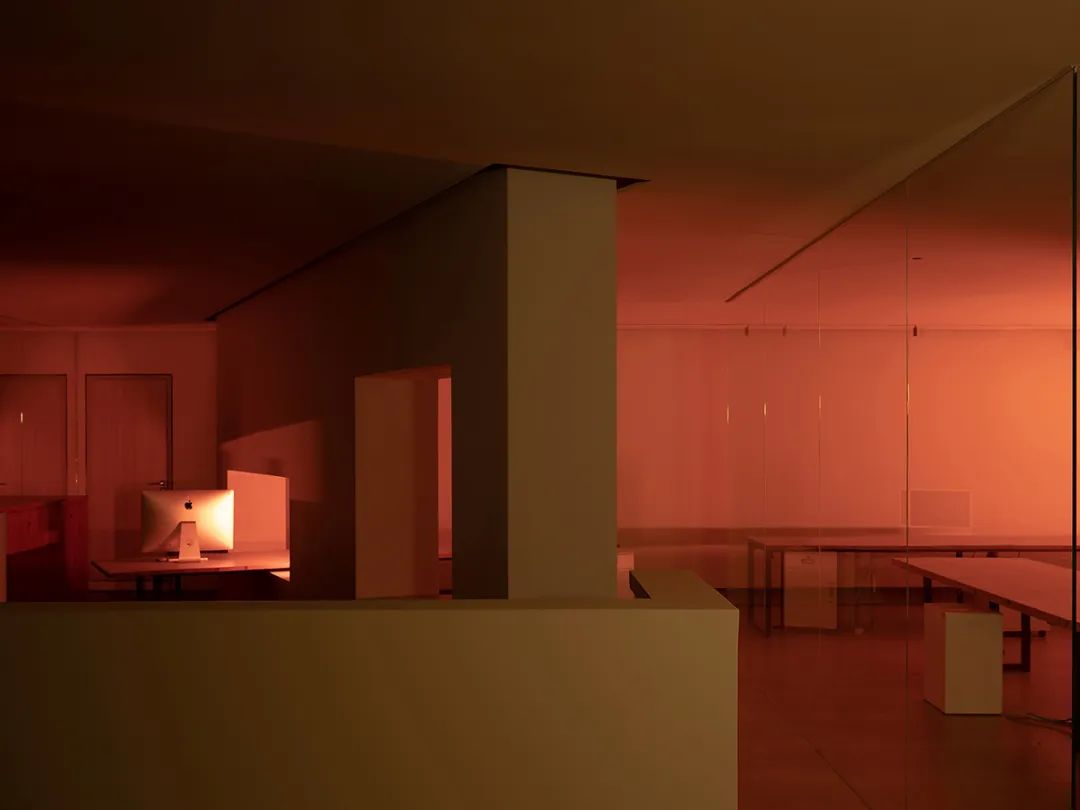
In terms of soft furnishings design, the space does not pile up concrete Eastern symbols; instead, it conveys the Eastern stance through materials, light and shadow, and scale. In “Shui Garden,” elements such as furniture, utensils, flower arrangement, and tea art are naturally presented in the scenes, becoming carriers of the integration of culture and commerce. On the screen wall at the entrance to the office area, “Peek” and “Niche” break the sense of seriousness between contraction and release, reflecting the designer’s exquisite control of details. The office lighting meets functional needs during the day and switches at night to a Forbidden City orange tone, creating an atmosphere unique to the East and enhancing the cultural added value of the commercial environment.
Cultural Strategy in Commercial Environment Design
As a cultural media brand, Shui Zui Zhongguo achieves the unity of content and site through this space. The two spaces are like “two sides of one body”: they are both a place for the team’s daily creation and a platform for external cultural exchange. After its completion, “Shui Garden” quickly became a venue for cultural, artistic, and design activities, demonstrating the key role of commercial environment design in extending brand value.
This space has no “tangible Eastern objects,” yet it presents an “intangible Eastern stance” in its overall atmosphere. In commercial environment design, it provides a referable paradigm for the office space of cultural brands—taking Eastern aesthetics as the core, human and nature as the thread, and through soft furnishings design and spatial strategies, constructing a contemporary workplace that is both spiritual and functional.


Lead Designers: Cui Shu, Li Hui
Address: Beijing, China
Area: 1,000 square meters
Keyword tags: media, China, Beijing, Eastern aesthetics, aestheticism, red brick, garden, commercial environment design, minimalism
 中文
 English
 Français
 Español
 Русский
 العربية
 Douyin
 Video